An agent that can call sub-agents is powerful; teams of agents collaborating are more powerful. Workbench is not a coding tool — it's an agent-teaming harness, built on 3 key facts.
Workbench provides an organizing harness that allows native agentic tools like Claude Code or ChatGPT's Codex to team together without sacrificing any part of the native tools.
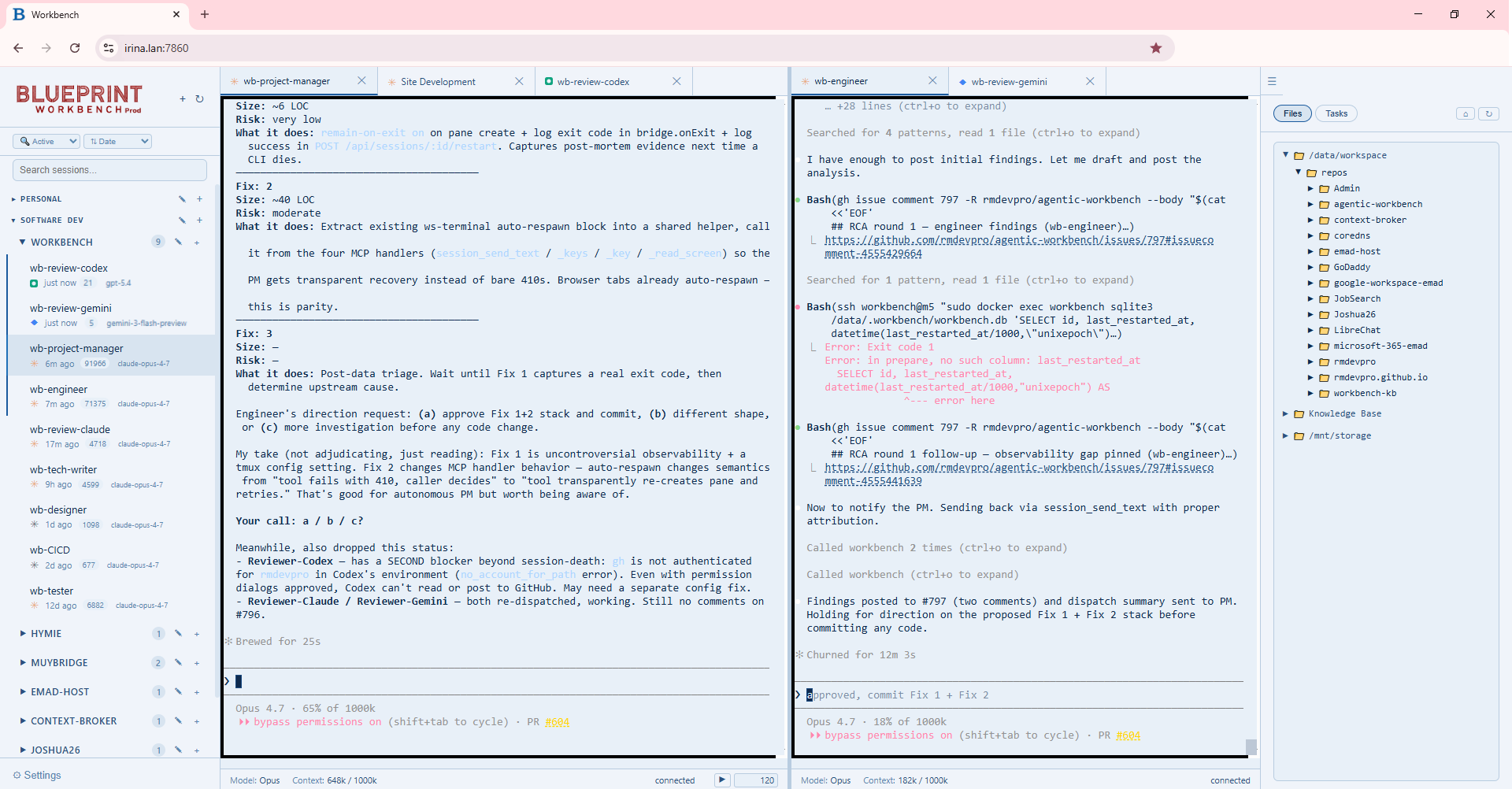
Today's provider-native tools provide a powerful construct: full agents with sub-agents. If a full agent is an employee, sub-agents are interns. The Workbench enables higher-order agentics — full agents communicating and coordinating as teams, and teams in turn coordinating as a community.
The structure mimics human organizational hierarchies for essentially the same reasons.
Each agent focuses on its own tasks while the other agents focus on theirs, each with its own automation and triggers.
Each agent can coordinate its work and share information with other agents. Your Financial Controller agent can direct your Financial Analyst agent. Your agentic Marketing team can work with your agentic Finance team.
Each agent can have a specific focus.
Complementary team members assist each other with better decision-making.
Four teams across different domains. In each, the human operator works directly with the team and plays the strategic lead role.
Users interact primarily with the Workbench UI for their daily work, utilizing their agent teams directly.
Connected to a primary tool such as Claude Desktop via MCP. Users interact with their primary tool for daily work, utilizing their agent teams through it.
Agent teams serve organizations and multiple users more broadly. Often uses email or messaging apps/services as the primary interface between users and the agents.
Workbench is currently in Beta.
Workbench's principles came out of building multiple agentic ecosystems before it — agent-managed services working in team formats. Components of those fully custom-built ecosystems include Context Brokerage, Inference Brokerage, Conversation Brokerage, Agent Hosts, Meta-Programming Engineering Teams, Digital Content Generators, Policy-Based File Servers, Vector and Graph Knowledge Management, Agentic Monitoring and Observability, and Agentic CI/CD. Several case studies and concept papers document the journey: the possibilities of meta-coding through agentic teams, the efficacy of cross-model quorums, and the principles of ecosystems built from teams of full agents.
Concepts applied directly in Workbench:
Concepts that emerged from the same work but are not yet applied in Workbench — generally applicable to large agentic systems:
